

-
You got it Nan. The iceberg rule is the "what to do" while the "show, don't tell" maxim is the "how to do it".
(if you hate literary theory, look away now)
As a writer you should always know more about your character then your writing shows. In modern and post-modern writing this knowledge is revealed successively by means of a narrator who can be a person with in the story or a third party, but who unlike 19th century narrators does not claim evoke a sense of omniscience. This shift, away from a narrator who knows everything, can enter everybody's head and reveal their feelings and thoughts has taken place gradually since the late 19th century and was - if I remember correctly- exacerbated by the experience of two World Wars, more particularly the senseless atrocities human beings inflicted on each other in the course of these, which lead to a departure from the idea that there is a master plan that is sensible and could be known. Consequently you don't really find proper omniscient narrators in modern texts anymore. Instead you have narrators that are selectively omniscient (i.e. know the thought's and feelings of one other character, and are otherwise as much in the dark as the reader. In the case of first person narrators, modern (and post-modern texts) often feature unreliable narrative voices, like the narrator of Poe's "Tell-tale Heart" or Charlotte Perkins Gilman's female narrator in "The Yellow Wallpaper".
Personally, I would wager that the early seeds of this ( the idea that life is complex and can never be fully understood) have their roots in the enlightenment with its leaning to rational thought to which -as much as to the growing urbanisation and industrialisation, which seemed to de-humanise men by turning them into slaves to machines, rather than working with the natural rhythms of day and night, etc.- the Romantics ultimately were a counter-movement. Romantic writers sought to re-discover nature and re-connect with emotions, albeit in tranquility (Wordsworth, I think, in the preface to the lyrical ballads, but might have been Coleridge, who said that poetry should be the overflow of powerful emotions recollected in tranquility).
-
Hmmm. Trying to model something doesn't quite work if you don't know exactly how you want it to look... back to the drawing board. Blagh.
-
Interesting tips on writing... *ponders*
-
Or rather, it's one aspect of the iceberg rule. Show, don't tell applies to the actual writing, while the iceberg rule also applies to the plotting -- the concept stage. You may never use the fact that this character wears size 10 shoes, but you know it. It's what's hidden under the surface. Depending on your own style of writing and the needs of your creativity, you, the writer, may have need of trivial knowledge like that to get a feel for the people in your story. And of course, the same principle of useless trivia that should only serve the writer applies to world-building.
Suspiro ergo sum. -
AngelusPrime said:
Interesting tips on writing... *ponders*
Not a storyteller here, but it's still interesting to read such things.
-
Terre said:AngelusPrime said:
Interesting tips on writing... *ponders*
Not a storyteller here, but it's still interesting to read such things.
Very interested, and attempting to be a good storyteller. ;) :D
* A child of five could understand this. Fetch me a child of five!
* Isn't it wonderful how cute weapons of mass distraction can be?
* Those are my principles. And if you don't like them, I have others. -
um... ok... i began writing primatively as a baby, then i wrote a short
story before i was 6. after that i got into writing in grade school, because
we had our own little newsletter sort of thing :) i know, how progressive.
well, it was san francisco in the 60's. anyway... no, i had never heard of
that rule. and all i knew of hemmingway was he hated women, he killed
himself, and he wrote depressing stories. i would read de sade before i
would read him, if that is any indication of how i view the guy.
i got a's and a+'s in writing, got put into advanced creative writing,
which was a senior class, when i was 14 starting high school, and
then i was in the junior college's version of a similar class at 17
when i went to SRJC. (i began school at 4 because my bd is sept.
and it's before they made that silly starting age rule)
anyway, thanks for letting me know about mister titanic and his
rule ;) i truly did not have an inkling. i write almost daily. on posts
i am lower case, but on real writing i am over zealous about proofreading,
grammar, oxford commas, too many, but oh, well...
i love soap opera, romance, comedy, and good sci-fi.
i do not like mysogyny or its counterpart, um, mysandry?
i'd have to see if that's a word.
anyway, i just had to clarify. i'm sure any of you here are
better at prose than mister freeze.
~^..^~ ladyfur -
True, Terre. Although with my style of writing, I tend to write the character's speech as I hear other's, or myself speak- loads of errors, but purposefully most of the time. My biggest issue is punctuation I think.
I have serious issues with it. ;)
"I didn't attend the funeral, but I sent a nice letter saying that I approved of it. " Mark Twain. -
terre, grim, they have changed things so much in online content
these days that it is cringe inducing to read, even most major
newspapers' articles.
i write with a ton of phonetics in my dialogues and in my
narrator's voice. some is for play on words type humor, but
most is for setting. i'm bad about using stereotypes but it's
fiction. you cannot have, for instance, southern characters
who sound like they are in boston, or vice versa. and since
my storyline is set far enough back that immigrants mostly
came from europe, their speech patterns are going to be
different than their progeny would have now. i also use a
lot of foreign words and psuedo foreign words or spellings,
again, for color and setting. and because i really like the
fancy letters we don't have in plain boring english.
i copy paste a bunch of those for convenience sake.
to me what matters is i have to feel like i'm right there,
that i care about the characters, that i hear them in my
head and see them. otherwise i can't write it and i don't
want to read it either.
i'm lost on a tanget here, sorry.
once upon a time i made art...
~^..^~ ladyfur -
I have to admit, I'm not a Hemingway fan, either, but I have to respect the huge influence his style made in modern prose.
* A child of five could understand this. Fetch me a child of five!
* Isn't it wonderful how cute weapons of mass distraction can be?
* Those are my principles. And if you don't like them, I have others. -
I'm rarely a fan of authors as people while I remain a fan of their books, and vice versa -- sometimes an aficionado of their biography, but not their work. And sometimes I absolutely loathe both, but still had to be familiar with them and even read some. Meh. The downside of graduate school. Gives you a damn thick skin.
But I still try to avoid teaching courses on twentieth century Russia. No scholarly detachment possible there.
Suspiro ergo sum. -
Terre said:
I wish more people were over zealous about proofreading. I've seen things published by big names that had a number of spelling and grammatical errors that should've been caught.
I can literally sit with a red pen over Anne Rice's works and need a new pen by the end of the second chapter. I found out that ever since the success of IWTV, all her work is published as is, no editing... I hated her even more after that.
-
Terre said:
The only one of her books I've read is IWTV and I'm glad I got it second hand for .99. I can't stand characters who wallow in self pity. As far as editing, everybody needs someone to copy edit. No one is perfect, all will make mistakes.
Yes, besides, by the time you're done writing even a short story, you read what you think you've written, not always what you've actually put down on the page. You need someone to yell "plot hole" and "did you let a toddler write that for you?"
Or else let your manuscript rest for several weeks. Me, I rarely have the patience.
Suspiro ergo sum. -
surochek said:
PS: there are authors I admire both as people and artists, yes there are!
Despite my job (teaching History and English lit, as well as linguistics) I have to confess, I have very few literary heroes. Tolkien for sure, not because of his pace(it sucks! No do not describe me another leaf, lichen , stone or piece of bark- I get it: I am in the Old Forest) but for the sheer size and his world building. Creating functioning languages with vocab and grammar- that has to be applauded.
Owen and Sassoon for showing the pity of war like no other; Perkins Gilman for a wonderful portrayal of a decent into madness brought on by the 19th century's favourite treatment for post-partum depression and changing women's treatment for the better with her writing. William Gibson because he is the godfather of cyberpunk and last, but not least, Harold Pinter (God rest his soul)- the menace and communication errors pervading his plays are, to me, the epitome of absurdist drama.
I really like Kafka, too.
Looking at the writersI enjoy reading, I wonder why I don't suffer from depressions, yet. -
surochek said:Terre said:
The only one of her books I've read is IWTV and I'm glad I got it second hand for .99. I can't stand characters who wallow in self pity. As far as editing, everybody needs someone to copy edit. No one is perfect, all will make mistakes.
Yes, besides, by the time you're done writing even a short story, you read what you think you've written, not always what you've actually put down on the page. You need someone to yell "plot hole" and "did you let a toddler write that for you?"
Or else let your manuscript rest for several weeks. Me, I rarely have the patience.
very true. That's why Itellmy high school pupils to finish a writing piece a couple of days before the deadline, so they can take a break before proof-reading, as that does make it easier to spot mistakes. -
Raetjor said:
very true. That's why Itellmy high school pupils to finish a writing piece a couple of days before the deadline, so they can take a break before proof-reading, as that does make it easier to spot mistakes.
Heee! College students still haven't learned it.
In grad school, some of our profs would take off one point per spelling mistake or typo. You learn self-editing REALLY fast when C is a failing grade.
Suspiro ergo sum. -
Since there's been some chat about storytelling, I just ran across this. Some good advice in here. *takes notes*
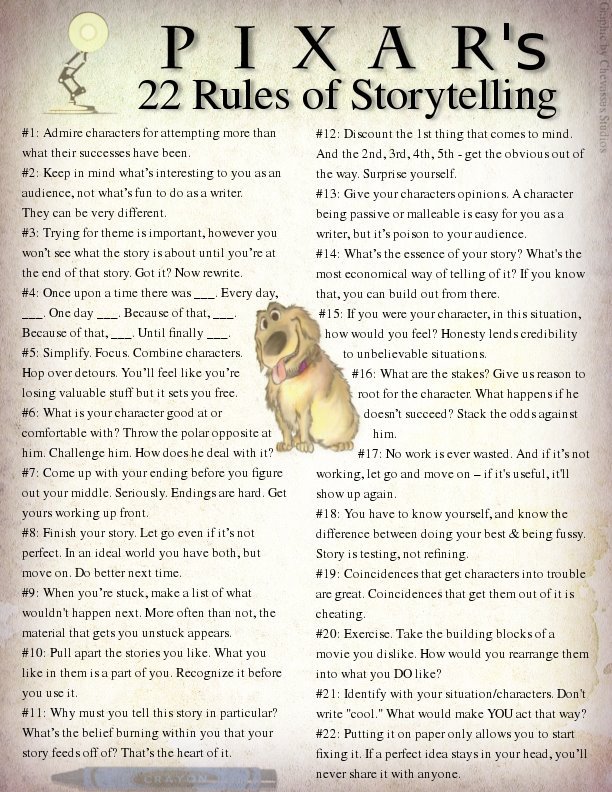
 547210_10151048877897292_1781489140_n.jpg612 x 792 - 160K
 -
Once upon a time, there was a (character - protagonist) in a (situation) who had a (problem, obstacle and/or personal flaw standing between the character and their goal - can also be the antagonist blocking them). The (character) (decided or was forced) to solve their (problem, obstacle and/or personal flaw). The character tried and tried. Sometimes it seemed they were getting closer to a solution, only to have their hopes dashed(light moments and dark moments). At last, when things were darkest, (climax) the character made one final, mighty attempt to resolve the (problem, obstacle and/or personal flaw). They (succeeded for most stories, failed for tragedies), and (denouement - reaped the rewards of success, or suffered the consequences). When at last it was over, the character had (changed, for most stories, suffered or died for tragedies). The end.
All stories fit this pattern.
No, seriously.
Picking a story at random - say, the movie "Alien".
Once upon a time there was [character] a woman named Warrant Officer Ripley [/character] who [situation]served with her crew of friends aboard the commercial towing spaceship, Nostromo.[/situation] One day while doing their space-ship thing, [problem]they picked up a strange transmission from an unexplored planetoid. The captain decided to land and check out the signal, but one of the crew was attacked by a mysterious egg-thingie. In very short order, there was [antagonist] a monster aboard the ship [/antagonist], and the crew was struggling to find a way to defeat it.[/problem] [light moments and dark moments]With no weapons, they had to improvise, as the alien slowly picked off the crew one by one. At last, Ripley discovers the terrible truth - it was all a ruse by the company. The android, Ash, had been programmed to divert the mission to the planetoid so that the alien could be brought back to earth for use as a bio-weapon - that the crew would be killed was unimportant to the company. With all her friends dead, Ripley attempted to flee to the shuttle, only to discover that the Alien was there.[/light moments and dark moments] In one final battle, [climax]Ripley manages to destroy the alien.[/climax] [denouement]Physically exhausted and mentally drained, a victorious Ripley sets the shuttle's course for Earth. She has changed over the course of this adventure from a relaxed and loyal company employee to a betrayed and angry warrior-woman.[/denouement] The End.
No, seriously. Let's do another: Brian's Song.
Once upon a time there was a [character]man named Gayle Sayers[/character], who was [situation]a running back for the Chicago Bears.[/situation] His goal was [problem or obstacle]to become the best running back in all the league, but he was still young and inexperienced, fresh out of college.[/problem or obstacle] To [forced resolution]solve this problem, the coach assigns him to be mentored by an older player, Brian Piccolo.[/forced resolution] Brian and Gayle work together. [light moments]Gayle sometimes pranked Brian[/light moments], but [dark moments]when Gayle was injured and it looked like his career might be over,[/dark moments] Brian got a weight machine and helped Gayle overcome his injury. Then, when Gayle's future and career were looking their brightest, [climax]his friend Brian suddenly came down with cancer. Gayle tells the team they will play for Brian, and give him the game ball - and he plays his best game ever.[/climax] [denouement]Brian is given the game ball, and dies. Gayle has changed over the course of the story, going from a young hot-shot college player in his first year of pro football to an experienced and skilled player the rest of the team respects. And yet, he will mourn his lost friend for the rest of his life.[/denouement] The end.
Seriously. All stories fit this pattern. Sure, the "climax" part of Brian's Song actually stretches out over the last quarter of the film. But, it still fits the pattern.
The essential element is that you have a character in a situation who has a problem. They try to resolve it in different ways - which can include trying to ignore the problem and hoping it will go away, but suffering the consequences for doing so. In the end, they make one final, climactic effort, and the problem is either resolved, or they fail. Either way, we should see the character change from who they were at the beginning. Sure, in a horror or tragedy, that change might be "they died." But it's still change.
Interestingly, this last part - Character Change - is the singular and most prominent point that marks episodic TV script writing from most other forms of literature. At the end of the story, the characters very often have NOT changed, and all they have accomplished is to restore things to exactly the way they were when the episode started. This way, the shows can be shown in syndication out of order, and it doesn't matter. Character change is critical to nearly every other form of writing, however, and should never be ignored.
Another element is the goal. Sometimes the goal is complex, like becoming a success at a career. Other times it's very simple - don't let the monster eat me. Either way, however, every character needs a goal, and something (or perhaps multiple somethings) that prevents them from achieving this goal. It can be a personal problem, or it can be another character who is directly blocking them (an antagonist). No matter what, however, the character needs a goal, and something that stands between them and their goal.
Lastly, the character's problem need not be readily apparent, it can be multi-layered, and it can sometimes be resolved simply by the character undergoing personal change. For example, in the movie "Up", the character's real problem is his wife has died, and he's sad, alone and very lonely. He decides to go on the adventure he and his wife always talked about - and in the process, a boy-scout kid gets taken along. Soon, they have new problems - someone the protagonist thought of since he was a child as a hero turns out to be a villain, and they must defeat him and find a way home. At the conclusion of the story, the protagonist has changed - we see in the denouement and the credits that he now spends time with the young boy-scout, and is living his life again. But, in the process of this change, he has resolved the problem that we were introduced to in the early part of the film - he is no longer sitting on his porch, sad and alone. He is happy. So, it doesn't have to be a straightforward "attack the problem until we solve it" situation, sometimes simply having the character change resolves his underlying problem, and accomplishes their goal.
And incidentally, THAT idea is actually the most common element of storytelling for Pixar. A protagonist's real problem is frequently laid out right in the first few minutes of the film, and is very often that they are sad and alone, or that they feel (or simply are) rejected. At the conclusion of the adventure, whatever the problem was that they had in the first few minutes of the film has been resolved. For example, Wall-E starts off his story as a lonely little robot slaving away pointlessly in a world filled with trash. At the end of the film, Wall-E is no longer alone, and as we see in the end-credits, the world is soon no longer filled with trash, but is green and clean again. Another example is the Pixar film "Toy Story." In the first few minutes of the film, we find out that Woody's real problem is he's afraid Andy doesn't love him anymore and won't play with him anymore, choosing the annoying and stupid Buzz Lightyear over him, a toy Woody hates. By the time the end of the film arrives, however, Andy most definitely has been shown to love Woody just as much as he ever did, and Buzz Lightyear, though still a doofus, has shown himself to be a brave and worthy friend to Woody.
So: These are the basic elements: A character who has a goal or a problem, and something (or someone) that stands between them and their goal or prevents them from resolving their problem. The meat of the story is the attempt to resolve the problem. And by the end of this process, succeed or fail, the character should have changed, becoming different than they were at the beginning.
That's all I can think of for the moment.
-
That's story structure in a nutshell, yep. A great little piece of advice/tool there, Jim. Thank you!
-
Yup yup yup
And since time immemorialMorphology of the Folktale, Vladimir Propp
Lord, I love folk tales
Suspiro ergo sum. -
LT_Roberts said:That's story structure in a nutshell, yep. A great little piece of advice/tool there, Jim. Thank you!
May I use the Alien breakdown as illustration? It's absolutely perfect.
Suspiro ergo sum. -
surochek said:
LT_Roberts said:That's story structure in a nutshell, yep. A great little piece of advice/tool there, Jim. Thank you!
May I use the Alien breakdown as illustration? It's absolutely perfect.
Sure.
Please note that a better and more detailed explanation of this particular storytelling analysis can be found here:
http://www.amazon.com/Science-Fiction-Writers-Workshop-I-Introduction/dp/0595225535
Although Barry is writing about science-fiction, I have learned that his basic story analysis technique applies to ALL stories, without exception. Tragedies, comedies, bodice-ripping romances, all of them. Character, goal, obstacle, light moments, dark moments, climax, denouement. Without fail, every story follows this pattern, from ancient folk-tales to modern Hollywood scripts. I highly reccommend Barry's book.
-
http://nerdsguidetoreading.com/Nerds_Guide_to_Reading/Popular_Science.html
Interesting list.
EDIT - and I'd be interested in hearing what you thought of these books. Gleick's Chaos really did influence my thinking. I'd add The Media Lab http://amzn.to/OzONBW which is old hat now, but pretty fascinating back in the day as far as predicting technology goes. Also the Robert Ardrey Naked Ape books and Julian Jayne's Origins of Consciousness in the Breakdown of the Bicameral Mind.
* A child of five could understand this. Fetch me a child of five!
* Isn't it wonderful how cute weapons of mass distraction can be?
* Those are my principles. And if you don't like them, I have others. -
*cough* OK, back to our writers workshop. :D Although the above books are foundational in terms of building a better iceberg. ;)
* A child of five could understand this. Fetch me a child of five!
* Isn't it wonderful how cute weapons of mass distraction can be?
* Those are my principles. And if you don't like them, I have others. -
I wish I had more time for reading/writing- Every time I sit down to try (an actual BOOK rather than on a screen or a pad/pencil/pen combo) I pass out. *Chuckle* Thank you for the tips, though! THIS time I'm cping the notes for when I have half a brain to re-read them over. ;) This past week has been tweaking my poor two brain cells left to the point one has jumped ship to leave the straggler behind- all because of one little thing I overlooked.
How IS everyone?!"I didn't attend the funeral, but I sent a nice letter saying that I approved of it. " Mark Twain. -
Headache today, and feeling swimmy-headed, even feverish. Probably weather-related: my foot said this morning that rain was coming within a day or two.
On the other hand, food helped some. *blitherblither*
* A child of five could understand this. Fetch me a child of five!
* Isn't it wonderful how cute weapons of mass distraction can be?
* Those are my principles. And if you don't like them, I have others. -
ArNanobot said:
PS - I can relate to the two brain-cells thing.
Are you blithering me? :D I can relate to the swimmy-headache, too, doll...*Pets* I'm sorry you've got that going on. Totally bummer, dude. I knew about the raining hitting up here, too, before it did. What they say about old wounds is true- not to mention the flare ups of "Old" disease I have in my joints. *Chuckle* We're weathervanes! Bio-wise, even."I didn't attend the funeral, but I sent a nice letter saying that I approved of it. " Mark Twain. -
Yep. It's the toe I had surgery on that complained. Made me hop, it did.
*is petted* *purr*
* A child of five could understand this. Fetch me a child of five!
* Isn't it wonderful how cute weapons of mass distraction can be?
* Those are my principles. And if you don't like them, I have others. -
Rendo Coupon! 15% off.
Enter Discount Code 062812B15P25 at Checkout · Expires June 30, 2012* A child of five could understand this. Fetch me a child of five!
* Isn't it wonderful how cute weapons of mass distraction can be?
* Those are my principles. And if you don't like them, I have others. -
I can imagine- I had three broken toes in one summer way back, talk about hopping? Eesh. *grin, pets!!* I don't use those coupons- if I can't get a discount without shelling out more than 25 bucks before I can use it. I scrounged up enough cash for a heavily discounted program for another project. From 50 to 17 bucks!
http://www.mightydeals.com/deal/wondershare-video-editor.html?ref=awnews"I didn't attend the funeral, but I sent a nice letter saying that I approved of it. " Mark Twain. -
recovering! Teacher's New Year gave me massive hang over. In the future: what ever you do, if you see me anywhere close to a " Jaeger bomb" shoot me!GRIM said:I wish I had more time for reading/writing- Every time I sit down to try (an actual BOOK rather than on a screen or a pad/pencil/pen combo) I pass out. *Chuckle* Thank you for the tips, though! THIS time I'm cping the notes for when I have half a brain to re-read them over. ;) This past week has been tweaking my poor two brain cells left to the point one has jumped ship to leave the straggler behind- all because of one little thing I overlooked.
How IS everyone?!
-
-
*tries not to melt* Why is it that despite the fact that my AC is cooling my room 20 degrees cooler than outside temperatures, I still feel hot....?*shuffles off to find some ice water*
-
Will keep that in mind, :)


Howdy, Stranger!
It looks like you're new here. If you want to get involved, click one of these buttons!